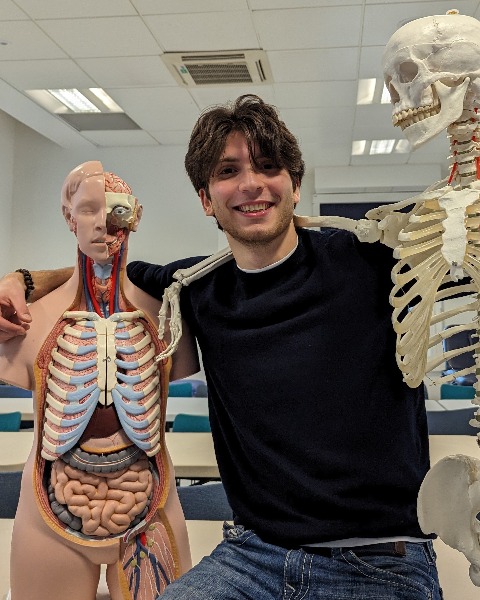
Introduction: The integration of augmented reality (AR) in medical education has garnered attention for its potential to enhance learning outcomes. This study investigates the effectiveness of AR in teaching neuroanatomy to medical students and its impact on academic performance.
Methods: A randomized controlled trial was conducted with 100 first-year medical students at Imperial College London. Students were divided into two groups: one group utilized traditional teaching methods, while the other engaged with AR-enhanced neuroanatomy modules using simXAR. Pre- and post-intervention assessments were administered to measure neuroanatomy knowledge and understanding. Statistical analysis was performed using paired t-tests to evaluate differences in scores.
Results: The results demonstrated a significant improvement in neuroanatomy scores in the AR group which utilized it, with mean pre-test scores of 65% (SD = 10.5) compared to post-test scores of 85% (SD = 8.3), indicating a 20% increase (p < 0.001). In contrast, the traditional group showed minimal improvement, with pre-test scores of 66% (SD = 9.2) and post-test scores of 70% (SD = 9.8), a mere 4% increase (p = 0.08).
Conclusion : The implementation of augmented reality in neuroanatomy education significantly enhances learning outcomes as evidenced by improved test scores. This study supports the incorporation of AR technology into medical curricula, providing a more interactive and engaging learning environment that fosters better understanding of complex anatomical structures. Future research should explore long-term retention of knowledge and the applicability of AR in other medical disciplines.

.jpg)